

If you have ever had an idea for an internal agency tool and stopped yourself because you do not know Python, that is exactly the problem vibe coding solves. The block is not intelligence. It is syntax. You already understand the business logic. You know what the tool needs to do, what it should take as input, what the output should look like. The only thing between you and a working tool was the need to translate that thinking into code. Vibe coding removes that translation requirement entirely. You describe the logic in plain language. AI handles the rest. This post explains what is vibe coding, how the workflow actually runs, where it breaks down, and how to start today without any technical background.
What this post covers: What is vibe coding AI, how it differs from prompt engineering, and who it is built for. The step-by-step workflow, real tools agencies are building, and the four places where it still fails. Aimed at founders, creative directors, and agency operators who want to build without hiring a developer.
Table of Contents
What Vibe Coding Actually Means
Vibe coding is building software by directing AI with logic descriptions instead of writing code yourself. The term was coined by Andrej Karpathy in early 2025 and spread quickly because it named something practitioners were already doing informally.
The name sounds casual. The discipline is not. Vibe coding still requires you to think clearly about what a system needs to do. You are the one who understands the business problem, the edge cases, the user flow. AI handles the translation from that thinking into Python, JavaScript, or whatever language the job requires.
The distinction that matters: a prompt engineer writes better instructions to get better text output. A vibe coder writes instructions to get working software. The output is a functional tool, not a piece of content.
For B2B agency operators, this matters because your bottleneck is rarely ideas. You have those. The bottleneck is build capacity. Every custom CRM, every automated reporting dashboard, every client-facing intake form you have not built is a process running through spreadsheets or manual emails instead. Vibe coding is the path between the idea and the tool, with no developer in the middle.
Why Non-Coders Can Now Build Real Software
The shift happened because foundation models got genuinely good at code, not just text. According to GitHub’s 2024 Octoverse report, more than 55% of code in GitHub Copilot-assisted projects was AI-generated. That number has moved up since.
What changed for non-coders is not autocomplete. Claude, GPT-4o, and Gemini can now hold enough context to build multi-file applications from scratch. They remember what you built in step one when you are asking about step five. They catch their own errors when you describe the problem in plain English.
The workflow is: describe the problem and the desired behavior. The AI produces a first version. You test it, note what is wrong or missing, describe the fix in plain language. Repeat. You never write a line of code yourself.
This is exactly where the “I don’t know Python, am I stuck?” concern falls apart. Python syntax is not what you need. You need to describe what the software should do, step by step. That is a thinking skill, not a coding skill. If you can write a standard operating procedure or map a business process, you can vibe code.
You can explore more AI workflow approaches on the ByHarshal blog, where Harshal documents the systems he runs at Square Root SEO.
How the Vibe Coding Workflow Works
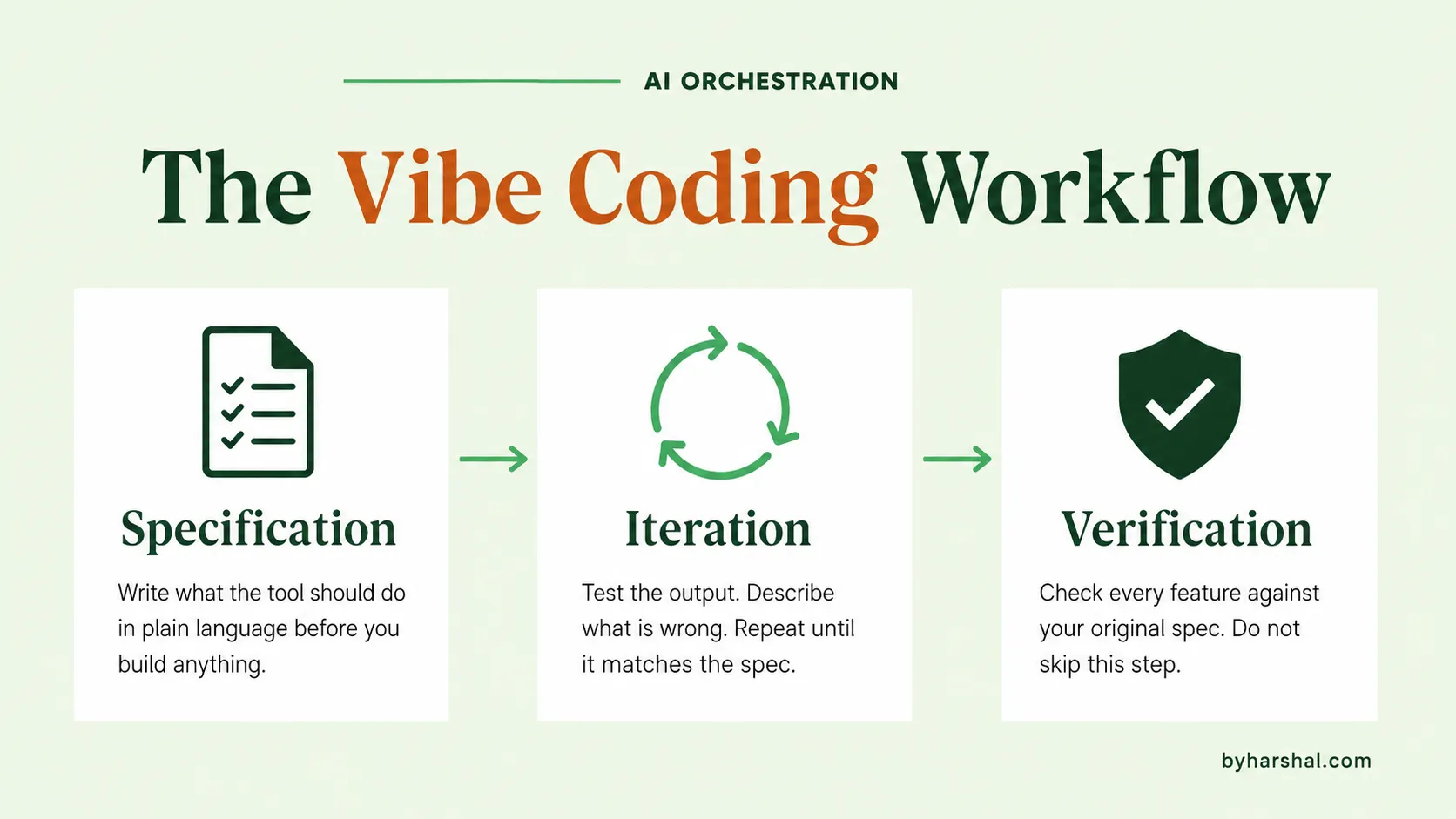
The process has three layers: specification, iteration, and verification.
Specification is writing what you want the tool to do in plain language. Not one line. A real spec. What inputs does it take? What does it do with those inputs? What does the output look like? What happens when something goes wrong? The more specific this document, the less back-and-forth later. Treat it like a brief you would hand to a contractor.
Iteration is the actual build loop. You give the AI your spec, it produces a first version, you test it, you describe what is wrong. This is not prompting for better sentences. You are debugging a system. The language sounds more like: “The export is saving to the wrong folder when the filename has a space in it. Fix that.” Then you test again.
Verification is where most beginners underinvest. Every feature you add needs testing against your original spec. What you described should match what the tool actually does. Vibe coders who skip this step ship tools that work in demos and break in production.
The tools most used in this workflow: Claude for complex logic and multi-step builds, Cursor or Windsurf as AI-native code editors, and Replit or GitHub Codespaces for running the code without setting up a local environment. You do not need all of these. Start with one AI and one editor. Add tools only when you hit a specific limit.
The AI Orchestra Workflow at ByHarshal documents how to structure multi-step AI systems once you move beyond single scripts.
Real Examples: What Agencies Are Building
The clearest way to understand what is vibe coding AI in practice is to look at what people are actually shipping.
A content agency built a keyword clustering tool that took SEO exports, grouped related terms by intent, and output a formatted brief. The founder had no coding background. The build took three evenings.
A B2B SaaS consultancy built an internal Slack bot that pulled weekly activity summaries from their project management tool and posted them to a client channel automatically. Before the bot, a team member spent two hours every Friday doing this manually.
A small SEO agency built a lead scoring spreadsheet connected to a lightweight web scraper that enriched inbound leads with company data before sales calls. This replaced a paid tool that cost $400 per month.
None of these are technically complex. All of them required clear thinking about the business logic. That is the job. Write the logic clearly, test the output against reality, adjust when it breaks. The AI is executing. You are directing.
See how we apply vibe coding and AI orchestration in our recent client work.
Where Vibe Coding Still Breaks Down
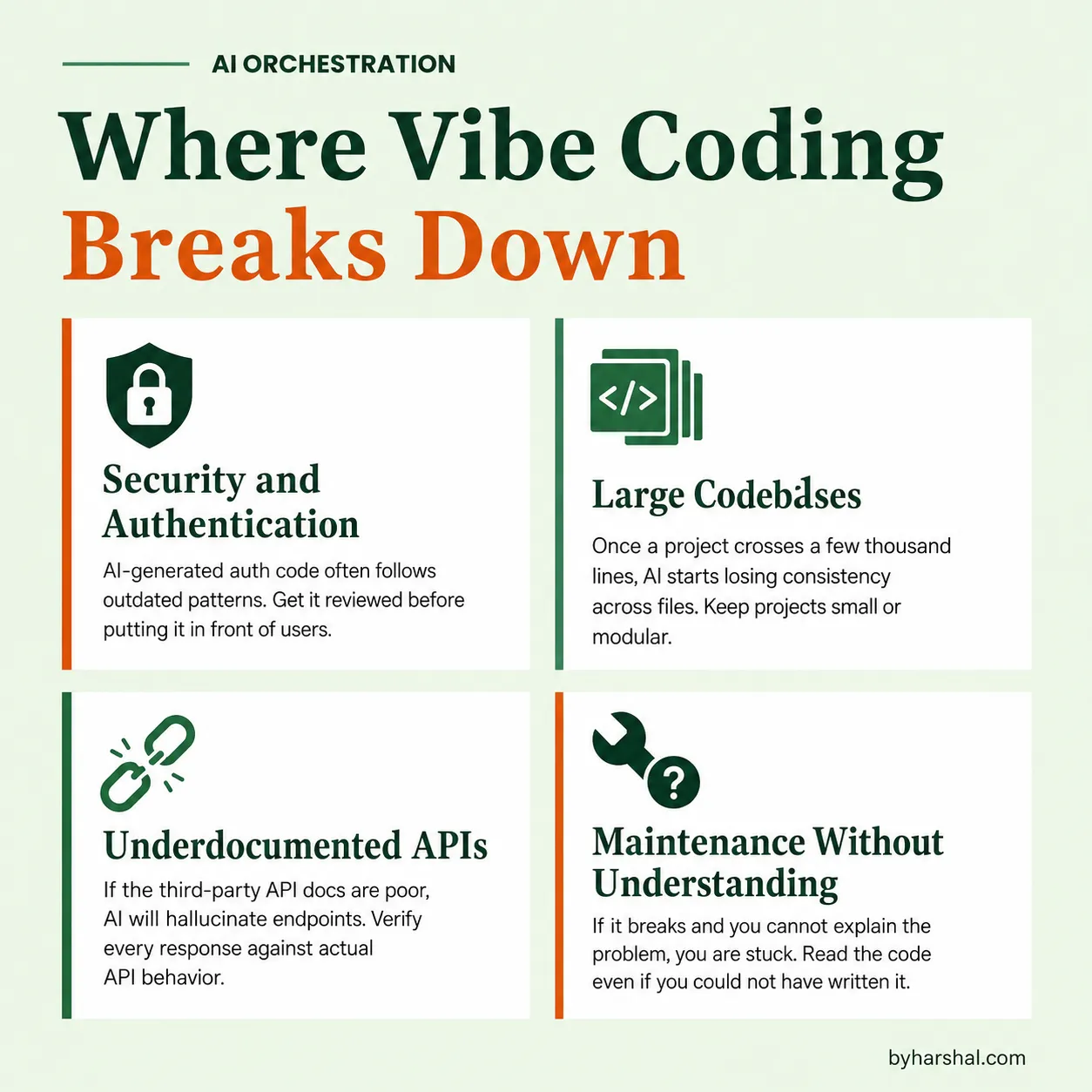
Knowing what is vibe coding also means knowing where it stops working. There are four consistent failure points.
Security and authentication. If your tool handles user logins, payment data, or sensitive client information, vibe-coded solutions carry real risk. AI-generated auth code often follows outdated patterns. If security is in scope, get it reviewed by someone with a security background before putting it in front of users.
Large codebases. Vibe coding works well when the project is small enough to hold in context. Once a project exceeds a few thousand lines of code, consistency breaks down. AI starts forgetting earlier decisions, producing conflicting implementations across files. The solution is to keep projects small or modular, not to push through the size limit.
Integrations with underdocumented APIs. If the third-party service your tool needs to connect to has poor documentation, AI will hallucinate endpoints. This is fixable, but it slows the build cycle and requires you to verify responses against actual API behaviour.
Maintenance without understanding. If something breaks in production and you do not understand the code well enough to explain the problem, you are stuck waiting for the AI to guess correctly. This is the long-term cost of building without learning. Some founders treat this as acceptable. Others find it paralyzing six months in. Invest some time reading what the AI produces, even if you could not have written it yourself.
None of these are deal-breakers. They are known limits. Build around them, and be honest about when a project has grown past what vibe coding alone can hold.
Getting Started: Your First Vibe Coding Project
Pick the smallest problem in your current workflow. Not the most impressive one. The smallest one.
Write a spec. One page, plain language. What does this tool take as input? What should it output? What are the edge cases? What does failure look like?
Open Claude. Paste your spec. Ask it to build the solution in Python. Run the output. Test it against your spec. Note what does not match. Describe the fix. Repeat.
Do not start with a web app. Start with a script. Scripts are easier to test, easier to debug, and closer to the business logic than anything wrapped in a UI.
The first tool you build will probably be rough. That is expected. The skill is in iteration, not in getting it right the first time. What you are building, more than the tool itself, is a mental model for how to think about software as a system. That model compounds with every project.
According to Stack Overflow’s 2025 Developer Survey, 76% of developers now use AI tools in their workflow. Non-technical founders are not late to this. They are entering at the exact moment the floor is low enough to walk in without a technical background.
For a broader view of how vibe coding fits into a full AI workflow practice, connect at byharshal.com/contact.
Key Takeaways
- Vibe coding is building software by describing logic in plain language to AI. You never write the code yourself.
- The bottleneck for non-technical builders is not syntax. It is the ability to specify clearly what a system should do.
- The core workflow is specification, iteration, and verification. Skipping verification is the most common failure mode.
- Claude, Cursor, and Replit cover most of what you need to start. You do not need a full local dev setup.
- Real agency tools, including keyword clusterers, Slack bots, and lead enrichment scripts, are being built in days.
- Vibe coding breaks down at security, large codebases, underdocumented APIs, and maintenance without understanding.
- Start with the smallest problem in your workflow. Build a script, not a web app.
Frequently Asked Questions
Do I need any coding background to start vibe coding?
No. You need the ability to describe a process clearly and think through edge cases. If you can write a standard operating procedure, you have the core thinking skill. AI handles syntax. You handle logic.
What AI tool is best for vibe coding?
Claude is generally the strongest for multi-step builds and reasoning about system design. Cursor adds a code editor layer that speeds up the iteration loop. Start with Claude in a browser if you want the lowest friction entry point.
How long does it take to build something useful?
A single-function script, such as a file renamer, data formatter, or API caller, can be built in an hour. A more complex tool with multiple features and error handling takes a few days of iteration. The timeline depends on how clearly you have specified the problem, not on technical complexity.
What happens when the code breaks and I cannot read it?
Describe the problem in plain English. What you expected to happen. What actually happened. Any error messages you see. Paste that into the AI. In most cases it can diagnose and fix the issue. If it cannot, that is a signal the tool has grown past the scope where vibe coding alone is sufficient.
Is vibe coding a real skill or just a shortcut?
It is a real skill. The work is in thinking precisely, writing good specifications, testing against requirements, and knowing when to bring in a developer. AI is a tool in that process. The judgment is yours.
Harshal Saraf is a Creative Director and AI Workflow Consultant based in Indore, India. Under his practice ByHarshal, he sets up AI workflows for founders, agencies, and brands across India. Where Creative Direction Meets AI Orchestration. He has led creative direction for brands and small and medium scale B2B businesses, and currently works as Creative Director and AI Strategist at Square Root SEO. He writes Oh, So AI, a Tuesday and Friday newsletter on AI tools, workflows, and productivity for founders and creatives.